
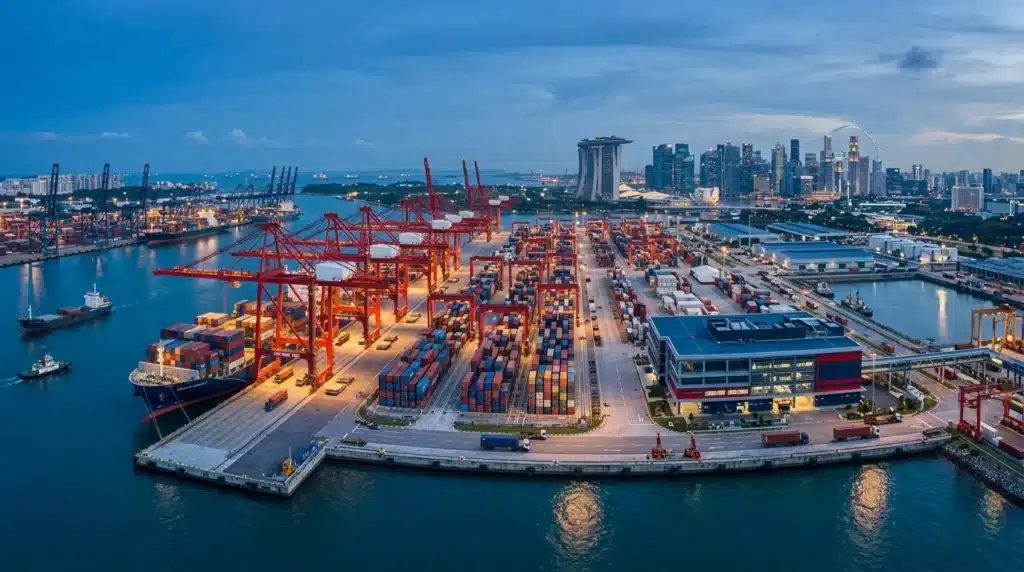
Exporting from Singapore in 2026: How Do New U.S. Tariffs Affect Your Corporate Structure?
The recent decision by the Office of the United States Trade Representative (USTR) to apply a 12.5% levy on certain exports originating from Singapore has raised concerns among international investors. If you are considering how to set up a company in Singapore to centralize your international distribution operations, it is essential to understand the details of this protectionist measure.
Does this mean the end of the city-state’s trade advantages? Not at all. The key to mitigating this impact lies in understanding technical exemptions and designing a robust logistics structure.
TL;DR: The Regulatory Essentials
- 12.5% Tariff: Applied by Washington due to disagreements over the oversight of forced labor in third-country supply chains.
- Limited Impact: The measure affects approximately one-third of Singapore’s direct domestic exports to the U.S. market.
- Exempt Sectors: Pharmaceutical components, semiconductors, aerospace equipment, and energy remain completely tariff-free.
- Legal Substance Matters: Proving the origin of components and the actual transformation of goods within Singapore is the only secure path to protecting your margins.
The Root of the U.S.-Singapore Tariff Dispute
The origin of this customs surcharge stems from an investigation initiated by the USTR into goods originating from economies that, in their view, lack sufficient controls against the indirect import of goods produced with forced labor in complex supply chains.
The Ministry of Trade and Industry of Singapore (MTI) has categorically rejected the basis for this duty, defending the country’s excellent regulatory track record on labor matters within its land and port borders.
This is not a structural failure of Singapore’s legal system. Rather, it is a direct consequence of global geopolitical tensions and the tightening of rules of origin that the United States is demanding from its trading partners in 2026.
Affected Sectors vs. Exemptions When Exporting from Singapore
To project the financial viability of your next commercial subsidiary, it is necessary to discern exactly which goods are subject to the 12.5% levy and which maintain the privileges of the bilateral Free Trade Agreement.
| Export Category | U.S. Tariff Status | Recommended Strategy in 2026 |
|---|---|---|
| Semiconductors and microchips | Exempt (0%) | Map the origin to certify that the silicon does not come from sanctioned regions. |
| Pharmaceuticals and active ingredients | Exempt (0%) | Ideal for biotech holdings exporting directly to North America. |
| Consumer manufacturing and base metals | Subject to 12.5% | Origin audit required to prove substantial local transformation. |
| Selected aerospace components | Exempt (0%) | Leverage Singapore’s special customs regime for aeronautical assembly. |
What happens if your specific product falls into the penalized range? The solution is never to halt the project, but to refine origin documentation to demonstrate that value added is generated legitimately within Singaporean territory.
How Does This Influence Taxes and Tax Planning?
Many entrepreneurs fear that these tariff tensions will cloud the benefits of operating in the region. However, the rules of the tax game remain extraordinarily favorable. When analyzing Taxes in Singapore: Complete Guide to Taxation and Tax Benefits, it is clear that the territorial-based tax model remains unchanged. Profits generated outside the national territory that are not repatriated continue to enjoy tax exemptions, and the local corporate rate maintains its 17% cap.
The priority for any international holding looking to How to Obtain Residency in Singapore: Visa Types and Requirements in 2026 is to provide its structure with real economic substance.
North American and European authorities closely monitor shell companies. Having a physical office, qualified address, and transparent accounting operations in Singapore not only dispels tax doubts but also acts as a shield against USTR tariff investigations.
The Expert Perspective from Singapore Way: Mitigating Tariff Risks
Variations in U.S. trade policy require CFOs to evaluate their supply chains with a clinical eye. The real risk is not the tariffs themselves, but the lack of traceability in manufacturing processes.
“The imposition of this 12.5% customs surcharge seeks to force corporate transparency. Companies that can certify the clean provenance of every component through rigorous audits will bypass barriers and consolidate their market share in the U.S.”
Case Study: Restructuring a European Tech Firm
Last month, a client dedicated to the design and assembly of industrial display modules came to our consultancy. Their goal was to move their headquarters to Singapore and make recurring shipments to distributors in Texas and California. With the entry into force of the new USTR regulations, their profit margins were at risk of dropping significantly due to unfounded suspicions about their Asian raw material suppliers.
Our team coordinated a deep technical analysis before proceeding with the registration of their new limited company. We determined that, although some secondary inputs came from regions under scrutiny, the precision assembly and quality testing were performed physically in Singapore.
Thanks to the structuring of corporate substance and the correct presentation of origin reports to customs authorities, we managed to classify their exports under a category free of the 12.5% surcharge. Simultaneously, the company’s founder and their executive team obtained their residency visas without experiencing any delays from immigration entities.
Action Plan to Structure Your Business Without Hiccups
If your operating model involves the cross-border transit of goods, we suggest applying the following measures before starting operations:
- Consult the Harmonized System (HS) code with specialized advisors to see if your specific merchandise falls into the third affected by the new tariffs.
- Establish solid contracts with your raw material suppliers that require periodic labor audits in compliance with international regulations.
- Avoid relying solely on disreputable transport intermediaries; use authorized logistics operators in Singapore that guarantee origin documentation.
Singapore’s legal certainty remains unmatched in the region. The key lies in anticipating tariff tensions with an impeccable corporate design.
Do you want to insulate your global business model against regulatory changes in the U.S. market? Visit our contact section and let us analyze your relocation case with no obligation to ensure an efficient and fully protected corporate transition.