
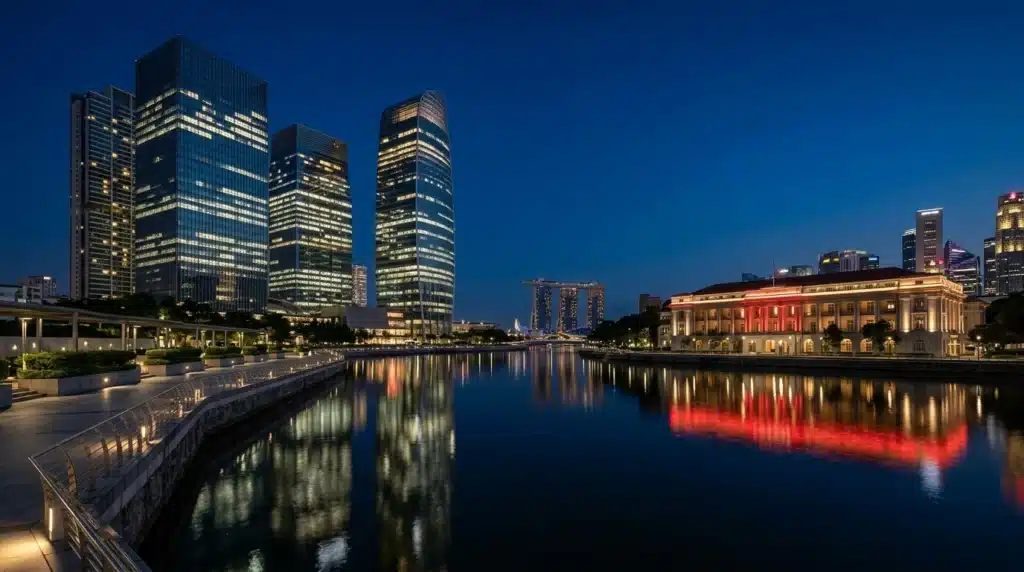
Investment Protection in Singapore: ICSID Opens Its First Global Office Outside the U.S. in 2026
- Institutional Milestone: The International Centre for Settlement of Investment Disputes (ICSID), part of the World Bank Group, is establishing its first permanent office with onsite staff outside of Washington in Singapore.
- Legal Guarantee: The arrival of this body consolidates the city-state’s legal security for foreign capital in a fragmented global environment.
- Strategic Headquarters: Operations will be managed from Marina Boulevard and the prestigious Maxwell Chambers Suites facilities.
- Direct Impact: International investors using Singaporean corporate structures will have immediate, in-person access to the world’s largest arbitration forum.
Legal certainty is no longer a secondary factor when structuring international wealth. In the current geopolitical context, high-level entrepreneurs seek jurisdictions that offer not only tax optimization but also an unassailable legal shield. The opening of the first overseas office of the ICSID in Singapore confirms that the city-state has become the epicenter of global financial and commercial dispute resolution.
Why is the World Bank making this decision now? The answer lies in the increasing complexity of cross-border disputes in the Asia-Pacific region. By centralizing its regional operations here, the ICSID offers investors and governments a neutral, efficient, and internationally backed forum to resolve discrepancies without having to resort to local courts in developing nations.
A Secure Environment for Cross-Border Capital
Setting up a company in Singapore has always been linked to the pursuit of stability. Since its independence, the Singaporean government understood that to attract foreign direct investment (FDI) flows, it was essential to offer robust protection mechanisms. In fact, Singapore has been a member state of the ICSID Convention since October 1968, demonstrating a historical commitment to an international order based on clear rules.
With the physical opening of this delegation led by experts like Frauke Nitschke and Jon Chevry, the country’s legal ecosystem takes a qualitative leap. This physical infrastructure will allow complex arbitrations to be managed on-site, reducing logistical costs and resolution times for multinationals and family offices with assets distributed throughout Asia.
“We are not interested in a world where outcomes are decided primarily by the size and strength of nations, but by the rule of law,” declared Edwin Tong, Singapore’s Minister for Law, during the inauguration ceremony.
Comparison of Investment Dispute Resolution
To understand the change this opening represents for entrepreneurs operating from the Malay Peninsula, it is useful to analyze how the operational landscape is shifting:
| Key Factor | Before the physical office | Current Scenario (2026) |
|---|---|---|
| Operational Support | Dependence on the Washington headquarters, with time differences of up to 12 hours. | Real-time, in-person management and technical assistance from Marina Boulevard. |
| Dispute Prevention | Reactive mechanisms once a conflict had already escalated to a diplomatic or judicial level. | Active advisory programs for regional governments to avoid unilateral measures. |
| Arbitration Infrastructure | Use of third-party rooms with limited availability for large-scale hearings. | Full integration with Maxwell Chambers Suites, world leaders in the field. |
This evolution is no coincidence. The country is also positioning itself to host the future Multilateral Investment Court (MIT), a permanent body that will complement current international arbitration functions and provide a two-tier system for conflict resolution processes.
Singapore Way Analysis: Legal Shielding in the Age of Uncertainty
Territorial taxation in Singapore is highly attractive, but tax advantages mean nothing if your assets face risks of indirect expropriation or arbitrary regulatory changes in the countries where you invest your capital. This is the true value of this news.
By structuring your investments in Asia through a private limited company (Pte Ltd) in Singapore, you not only benefit from a clean and transparent tax regime. You also place your assets under the umbrella of the Bilateral Investment Treaty (BIT) network signed by Singapore, which will now be managed with the direct support of the ICSID office on the island.
Last week, a client of our firm, a founder of a financial services technology company with development operations in emerging Southeast Asian markets, raised concerns about how to protect their servers and local contracts against the rise of protectionist policies in the region.
Our recommendation was clear: structure a holding company in Singapore regulated by ACRA and register technology transfer contracts under Singaporean law, subjecting them to the arbitration jurisdiction of Maxwell Chambers. The direct presence of the ICSID in the city provides this strategy with unquestionable institutional weight against any governmental counterparty.
Establishing your residency and companies in this Asian nation is not just simple cost optimization; it is a defensive move to ensure the continuity of your family and corporate legacy in the long term. If you wish to explore how to benefit from this environment of maximum legal protection for your international business, let’s analyze your relocation case without obligation and design a robust structure for your wealth.