
Cost of living in Singapore: housing, utilities, and food prices in
Explore an in-depth analysis of the budget required to establish residency in Singapore. Up-to-date technical information on the real estate market, utility costs, and purchasing power comparisons for international profiles.
General analysis of the cost of living in
Singapore is globally positioned as an elite financial hub, offering a quality of life proportional to its status. For those seeking to relocate their tax residency, it is crucial to understand that, although the cost of certain assets is high, the efficiency of services and low tax burden balance the personal financial scale.
According to official data from the Department of Statistics (SingStat), the consumer price index reflects a stable economy with world-class services.
Real estate market: rent and housing
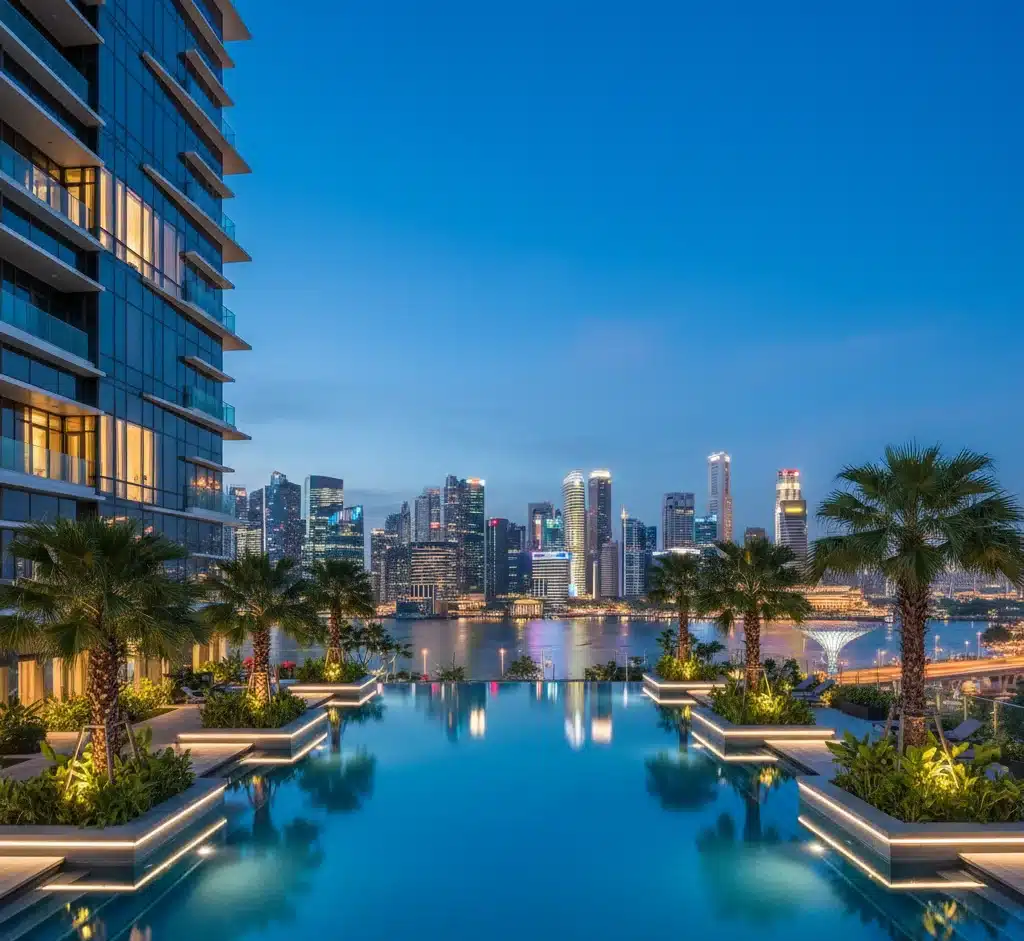
Housing represents the largest monthly expense for international residents. Singapore offers two primary markets: private condominiums (with amenities like swimming pools and gyms) and HDBs (high-quality public housing).
For corporate profiles choosing to incorporate a company, seeking accommodation in areas like Orchard or Marina Bay is common to maximize strategic proximity.
Singapore compared to other global financial hubs
For an international investor, the cost of living must be analyzed in relation to safety and business opportunities. In , Singapore competes directly with cities like Hong Kong, London, or New York.
Monthly budget simulator in
Adjust the parameters according to your profile to get a realistic estimate of your monthly expenses.
$0 SGD
*Includes housing, average food, public transit, and basic utilities.
Request tailored relocation planFood and dining options
Singapore offers a unique contrast. It is possible to eat very cheaply at Hawker Centres or enjoy some of the most expensive and exclusive dining experiences in the world.
Daily budget
Eating at local food centers (Hawkers) costs between $5 and $12 SGD per meal. A mid-range restaurant ranges from $40 to $100 SGD per person.
Grocery shopping
Imported goods (European cheeses, wines, or premium meats) have high prices due to import duties managed by Singapore Customs.
Transportation and urban mobility
Owning a private vehicle is extremely expensive due to the COE quota system, as detailed in our guide on importing vehicles. However, public transit is among the best in the world.
- 🚆 MRT and Bus: Monthly expenses between $80 and $150 SGD with absolute efficiency.
- 🚕 Taxis and Grab: A 20-minute ride costs between $15 and $30 SGD depending on demand.
- 🚲 Alternative Mobility: Expanding cycling path infrastructure supervised by the LTA.
Utilities and digital connectivity
Household maintenance and telecommunications costs are competitive compared to other global financial hubs.
- Utilities: Electricity, water, and gas for a 2-bedroom apartment are around $150 – $250 SGD monthly.
- Internet: High-speed fiber broadband (1Gbps) for about $40 – $60 SGD per month.
- Healthcare: Although public healthcare exists, international residents typically opt for private insurance, details of which can be found in our healthcare system section.
Estimated monthly budget distribution
45%
Housing
20%
Food
10%
Transportation
25%
Leisure and Others
Average salaries and actual purchasing power
The high cost of living in Singapore is offset by net salaries significantly higher than the European or Latin American average. Individuals relocating their legal residency typically experience a net increase in their available annual savings.
Strategic sectors
According to the Ministry of Manpower (MOM), salaries in technology, finance, and legal services for senior positions exceed $12,000 – $25,000 SGD monthly.
Wealth retention
By applying the benefits of territorial taxation, the capacity to reinvest capital is 30% to 50% higher than in jurisdictions with high tax pressure.
In conclusion, although Singapore is a premium city, the income structure and state efficiency make it one of the most profitable long-term financial decisions in .
Frequently asked questions about costs
Yes. By using public transit, eating at Hawker Centres, and renting rooms in HDBs, the cost of living can be drastically reduced without compromising safety or the quality of basic services.
International schools have fees ranging between $25,000 and $50,000 SGD annually. For more details, consult our education system section.
Plan your financial move with experts
We help you project your costs and optimize your tax structure for a successful transition to Singapore.
Request relocation consultancy